
In this article:
- What Is Skills-Based Hiring?
- How Skills-Based Hiring Differs From Traditional Credential-Focused Hiring
- Why Is Skills-Based Hiring Important: 7 Reasons Companies Are Shifting Their Approach
- How To Implement Skills-Based Hiring: 9 Strategies To Attract & Retain Top Talent
- Conclusion
Skills-based hiring has become that topic everyone pretends they fully understand, even though most people are still quietly trying to figure out what the hype is about. It seems like the job market finally hit a point where companies stopped caring about the framed paper on your wall and started caring about whether you can actually do the thing they need.
It is refreshing. It is overdue. It is changing how careers work in a very real way. Now the momentum is impossible to ignore. And this is where it gets interesting because there is more to it than meets the eye. This article will give you the full picture – what benefits skills-based hiring brings, and how you can implement it without complications.
What Is Skills-Based Hiring?
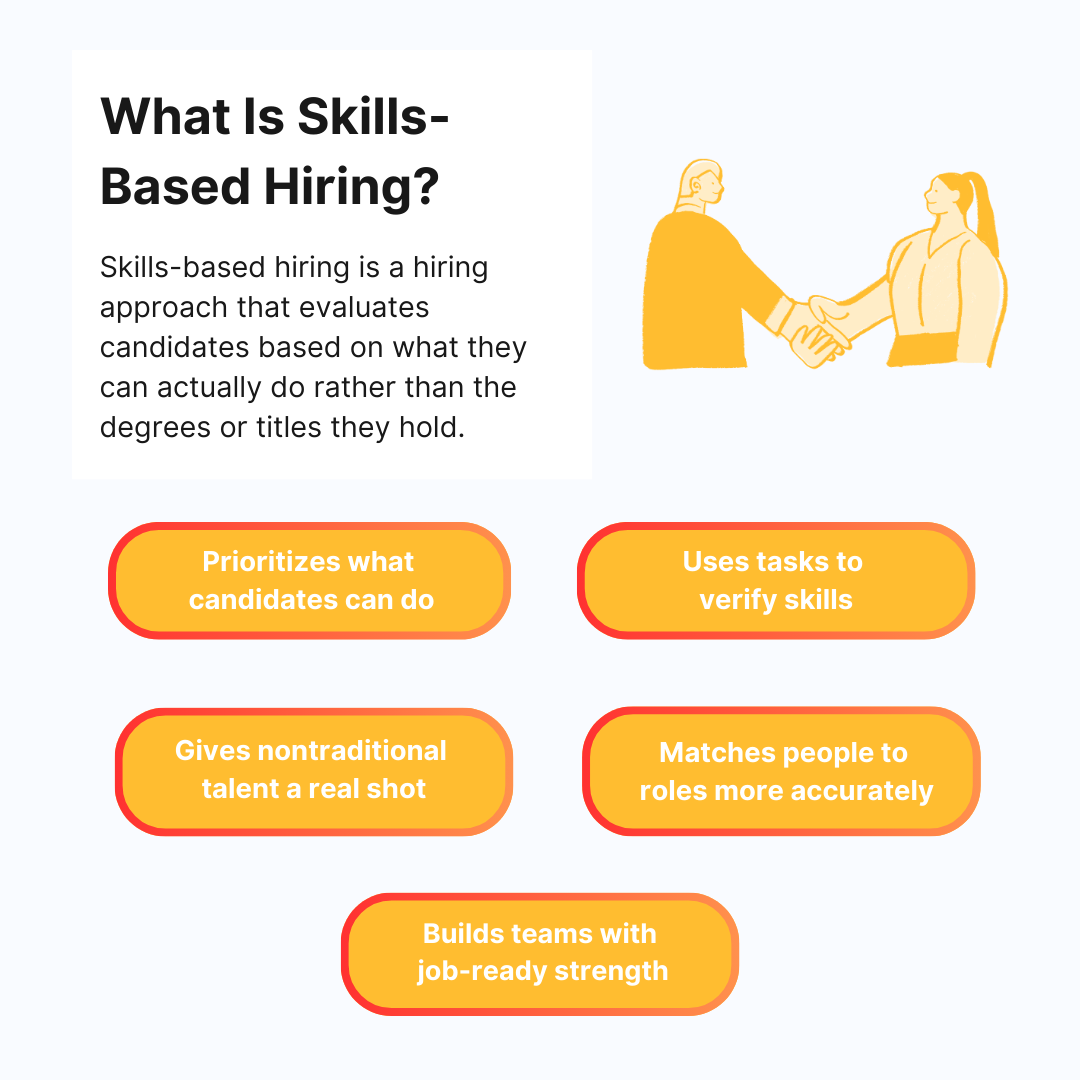
Skills-based hiring is when organizations make hiring decisions based on what a candidate can do rather than the degrees they hold or the titles they have had. It focuses on real, demonstrable abilities – technical skills, soft skills, role-specific competencies – and uses those as the primary filter for evaluating talent.
How Skills-Based Hiring Differs From Traditional Credential-Focused Hiring
For decades, hiring was mostly about the resume headline, but skills-based hiring pushes past all that. As you look at how each approach works, the differences start to feel massive. And that is exactly what we are discussing next.
| Skills-Based Hiring | Credential-Focused Hiring | |
|---|---|---|
| Primary Focus | – Actual candidate’s abilities – Practical skills – Real-world performance | – Degrees – Titles – Past employers – Years of experience |
| Evaluation Method | – Skills tests – Sample projects – Simulations – Portfolio reviews | – Resume screening – Qualification filters – Formal education requirements |
| Talent Pipeline | Stronger and more diverse because barriers are lower | Narrower due to strict credential requirements |
| Bias Risk | Lower, because decisions rely on demonstrated ability | Higher, because pedigree signals and assumptions influence decisions |
| Role Fit | Based on what a candidate can do today | Based on assumptions about capability from their background |
| Training Needs | Easier to predict because skills are visible and measurable | Harder to predict because credentials don’t always show skill level |
| Speed of Impact | Faster, since candidates are chosen for immediate capability | Slower, because credentials don’t always match the reality of job-ready skills |
Why Is Skills-Based Hiring Important: 7 Reasons Companies Are Shifting Their Approach
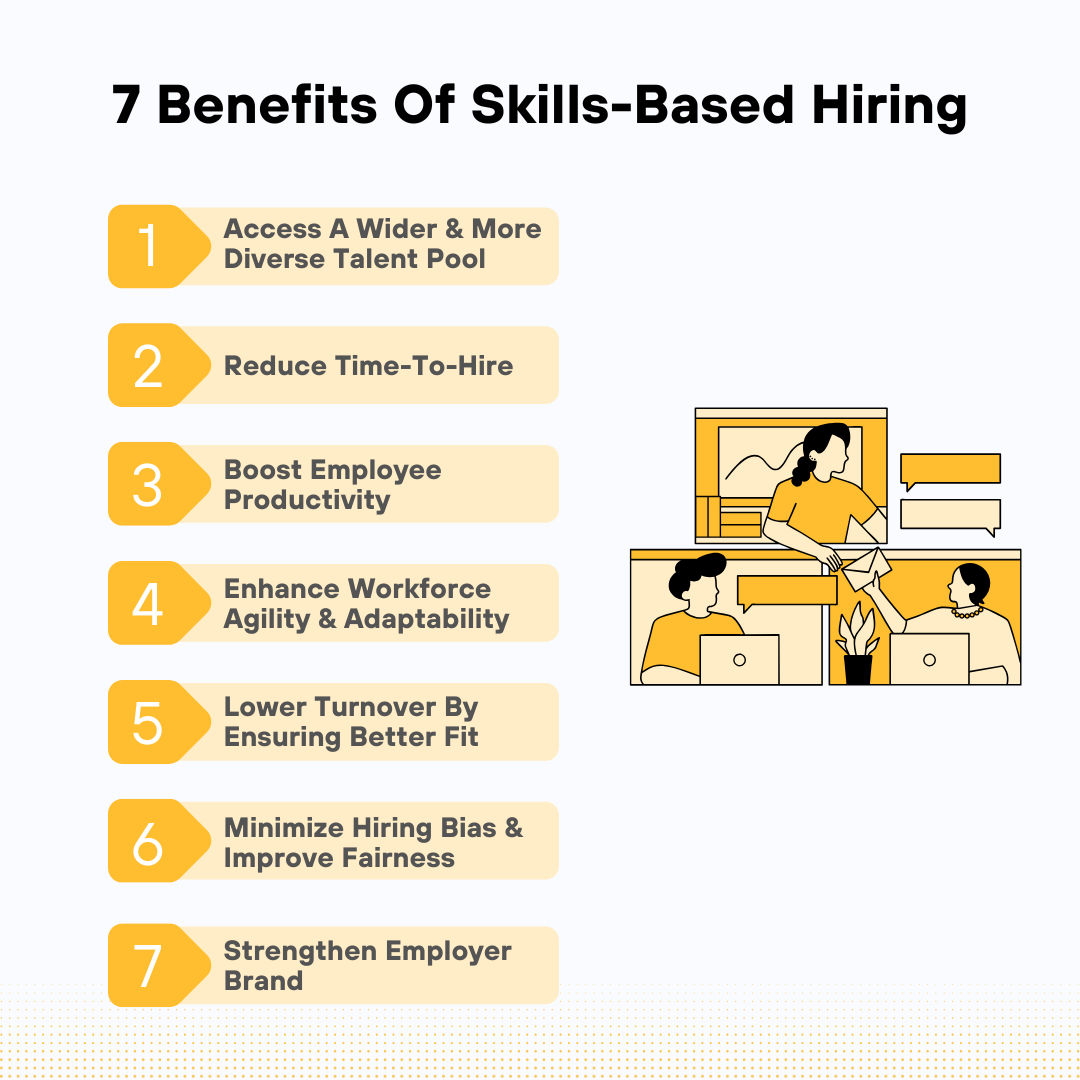
More companies are turning to skills-based hiring because it solves problems traditional hiring practices never could. Here are 7 reasons why businesses are making the shift.
1. Access A Wider & More Diverse Talent Pool
Companies are finally admitting something they avoided for years: their college degree filters kept shutting out people who could do the job better than the “qualified” applicants. Once they remove those filters, something interesting happens. Applications stop looking the same.
You Deserve Better Clients...
We can help you find them. Just send us the details and we'll hunt down leads that match your business needs. All on autopilot.
You start seeing people with unconventional career paths – the self-taught pros, the freelancers who have built real things, the part-timers who have been sharpening skills in the background, the remote workers from local communities with crazy potential.
This gives hiring managers candidates they never would have found through the old “must have XYZ degree” routine.
2. Reduce Time-To-Hire Through Precise Candidate Matching
Hiring gets faster when recruiters stop pretending job titles mean something. A “marketing manager” can mean 50 different things in 50 companies. But when teams create a skill checklist, matching becomes almost instant.
Rather than reviewing resumes, trying to figure out who can do the work, they look at skill evidence, and the decision becomes obvious. No endless interviews. You already know who can do the job before they walk in.
3. Boost Employee Productivity From Day One
Most onboarding lingers on because candidates were hired for what they might be able to do. Skills-based hiring practices change that, especially when supported by automated onboarding workflows.
Productivity shoots up because the person is already operating in their comfort zone. They have done similar work before, often repeatedly, so the first week becomes a continuation – not a reboot. You feel the difference instantly because you don’t have to micro-teach every detail.
4. Enhance Workforce Agility & Adaptability
One thing companies hate admitting – they rarely know what specific skills their employees actually have. They only know job titles. Skills-based hiring approach gives them a real snapshot of what every new hire shows up with, even skills that aren’t part of the official job description.
This becomes a huge advantage when priorities change. Need someone who can handle quick data cleanup? Someone who can jump into customer calls? Someone who can build a rough prototype? You know exactly who has what skill, so you can reshuffle people.
5. Lower Turnover By Ensuring Better Role Fit
People quit when the job feels different from what they were expecting. Skills-based hiring eliminates that surprise. Candidates see the exact tasks during the hiring process – sometimes through a quick assignment, sometimes through a demo.
They know exactly what the job is before saying yes. And managers see whether the person actually enjoys the work. That clarity keeps people in roles longer because they are doing work that is natural to them, not work they are forcing themselves through.
6. Minimize Hiring Bias & Improve Fairness
Bias tends to find its way in when you rely on assumptions – school names, previous employers, someone’s accent, someone’s personality during a 30-minute chat. When you shift to skills-based evaluation, all of that clears out.
You are comparing people on the same criteria. You are looking at the output rather than the background. And job candidates who usually get overlooked finally get the same shot as everyone else.
7. Strengthen Employer Brand & Market Reputation
Candidates talk. They tell friends which companies treat them fairly and which ones still act like it is 2005. When a company uses skills-first hiring, word gets around fast. Applicants see that they are being evaluated for what they can actually do.
Internally, employees feel proud because the bar is based on real ability. And on the outside, the company develops a reputation as a place where capable people thrive without having to fit a narrow mold. That reputation pulls in better applicants without extra effort.
How To Implement Skills-Based Hiring: 9 Strategies To Attract & Retain Top Talent
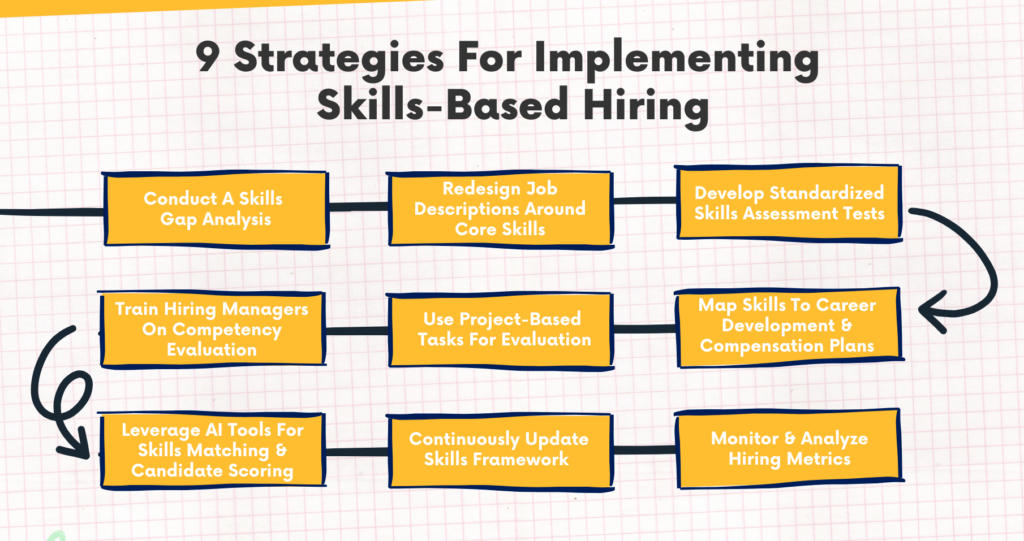
Shifting to skills-based hiring is one thing; making it actually work is another. Next, we will walk through 9 practical strategies to attract the right people and keep them performing at their best.
1. Conduct A Comprehensive Skills Gap Analysis
Before you can hire for skills, you should know what essential skills your team actually needs. A skills gap analysis shows exactly what your team can do today versus what they will need to reach future goals.
What to Do:
- List every critical role and its required skills. And go beyond titles. For example, don’t just list “marketing” – list SEO, content strategy, email automation, analytics interpretation.
- Ask each employee to self-assess, then verify through past projects or manager feedback. Use a simple scale (beginner, intermediate, expert).
- Identify skills that will block upcoming projects or growth. These gaps are your immediate hiring priorities – everything else can wait or be addressed with employee training.
Example:
When you do a real skills gap analysis, you want it to be honest, and that is exactly what this real estate specialist in Hilton Head did. They didn’t go in with a spreadsheet mindset. They literally started by sitting down as a team and talking through where agents felt out of their depth.
They found something interesting right away. Their agents were amazing with in-person showings, but more than half of the team admitted they struggled when buyers wanted video walk-throughs or wanted quick data around neighborhood trends.
So the company pulled up actual past deals and replayed the full journey – how fast agents responded to online leads, how well they used Follow Up Boss to track conversations, how confidently they explained pricing shifts using MLS market reports. It was a very human, real review. No one was sugarcoating anything.
That is when the gaps finally appeared. The places where work slowed down matched the exact places where skills were thin. And once they saw that pattern, hiring became a lot easier because the needs were ridiculously clear.
2. Redesign Job Descriptions Around Core Skills
Traditional job descriptions are riddled with “years of experience” and “bachelor’s degree required” language that pushes out capable candidates. Skills-based job descriptions focus on what people can do, not what they have done. This attracts unconventional applicants who are qualified.
What to Do:
- Put 5–7 core skills required for the jon at the top of the JD. Be precise: “Build automated workflows in HubSpot” is better than “CRM experience.”
- Include tangible outcomes – “Launch social campaigns that increase engagement by 15% in 3 months” is concrete and measurable.
- Scrap irrelevant requirements. Right skills matter more than where or how someone learned them.
Example:
Sewing Parts Online pulled up a few of their old job postings and immediately realized they sounded like every other eCommerce listing on the internet. Lots of “3+ years required,” but nothing that actually showed how their team works day to day.
So they started over from scratch. They opened a blank doc and asked one question: “What does someone actually need to walk in and do on day one?”
That little reset changed everything. For a customer support role, they listed the exact skills that make support strong in their world. They even added a short line about being comfortable switching between chat and voice because that is the way their buyers shop.
They also pulled real performance numbers from the past year to word their outcomes properly. For their marketing hire, instead of saying “experience with product launches,” they wrote, “Create product pages that convert as well as our top-performing sewing machine bundle pages.”
And once they removed the random “college graduates only” requirements and the generic “must have X years” thing, the postings started to sound like them – a team that cares about people who can actually do the work.
3. Develop Standardized Skills Assessment Tests
Assessments show you if someone can actually handle the work. They make hiring and evaluation consistent for everyone. Plus, comparing qualified candidates also becomes easy.
What to Do:
- Create role-specific tests. Simulate a client call for a sales role. For a developer, ask for a small coding challenge.
- Use a scoring rubric. Define exactly how many points each task or skill is worth. This lets you rank candidates fairly.
- Automate grading where possible. Tools like Codility or Vervoe can handle scoring for you.
Example:
EXT Cabinets took their skills assessments seriously because they were tired of guessing who could actually build and configure outdoor kitchen setups the way their clients expect.
So they built a small testing area behind their main showroom and turned it into a mini “outdoor kitchen lab.” Any applicant going for an installation or design role had to walk through a short task – match cabinet modules to a layout sketch, pick the right weatherproof materials for a coastal build, and flag any measurement issues that would cause trouble.
They also created a separate test for their design consultants. Instead of asking for a portfolio, they showed candidates 3 messy client inquiries pulled from past emails. Candidates had to sketch a workable cabinet layout using the EXT catalog and explain their reasoning in simple language a homeowner would understand.
Every applicant completed the exact same tests, scored the exact same way, which made comparisons easy and the final picks feel genuinely earned.
4. Train Hiring Managers On Competency-Based Evaluation
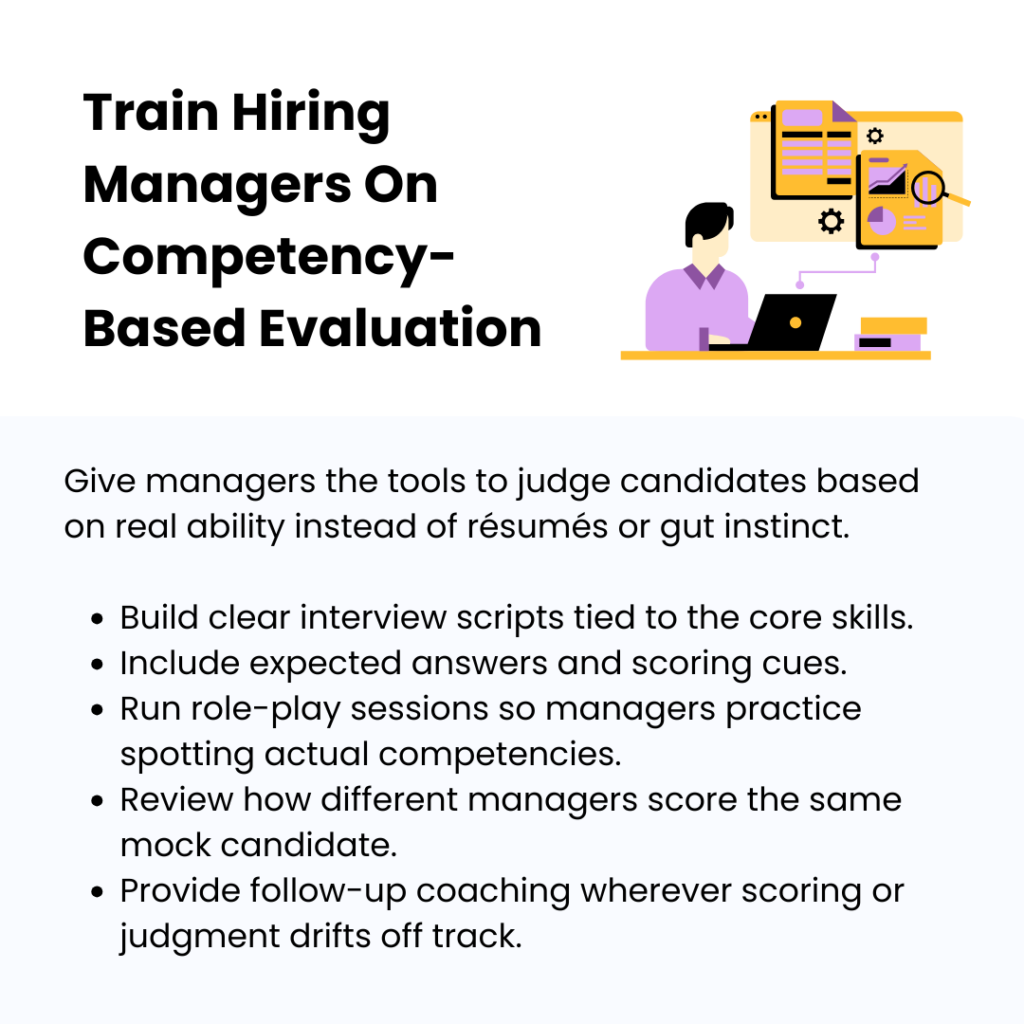
Even with tests, managers will default to gut feelings or get pulled in by certain resumes. Competency-based training helps managers focus on real ability rather than credentials.
What to Do:
- Create structured interview scripts for each core skill – a set of questions, expected answers, scoring guidelines.
- Role-play sample candidates. Highlight where bias might find its way in and how to focus on competencies.
- Compare how different managers score the same candidate to ensure calibration. Fix discrepancies with additional coaching.
Example:
This business-for-sale marketplace approached competency-based training in a very practical way because their hiring managers were used to scanning resumes from people with long backgrounds in sales or brokerage. They wanted to break that habit and get everyone focused on what was actually needed for evaluating and listing businesses on their platform.
So they pulled real examples from their Perth listings and turned them into short training scenarios. Each manager was given a complicated set of details from an actual seller inquiry. The exercise was simple – identify what is missing and explain how they would coach a seller to strengthen their listing.
They also recorded mock interviews using actual assessment scripts and had the team rate the same candidate independently. Everyone compared their scores afterward. Some managers realized they were giving extra points when someone talked confidently, while others were rewarding industry terms instead of actual competence.
They fixed this through short follow-up coaching sessions, where they reviewed specific answers and separated strong performance from strong “presence.”
5. Use Project-Based Or Simulation Tasks For Candidate Evaluation
Watching candidates actually do the work beats reading resumes every time. Project-based evaluations replicate real job tasks so you can see how they make decisions and solve problems right in front of you.
What to Do:
- Give candidates tasks they could realistically finish in 2–4 hours – draft a landing page copy, build a mini dashboard, analyze sample data.
- Evaluate process and not just output. See how they approach challenges and handle feedback.
- Debrief after submission. Ask candidates to explain their reasoning. Their thinking process is a skill on its own.
Example:
This custom patio cover kit brand depends heavily on project-based evaluations because its work requires precision and practical problem-solving. They wanted a way to see all of that without relying on long resumes from people who claimed to “know construction.”
So they started giving candidates a short, very real assignment: – take a customer’s rough patio dimensions and turn them into a workable kit recommendation. They provided the same inputs they get from actual customers, and the candidates had to choose the right kit and write a simple explanation they would send to the customer.
They also added a follow-up step where the hiring team gave small corrections – like a measurement they overlooked – and observed how quickly candidates adjusted without getting flustered. The whole setup mimicked real customer interactions and made it clear who could jump into the role smoothly.
6. Map Skills To Career Development & Compensation Plans
No, skills-based hiring isn’t just about getting talent in the door. It is about retention and workforce development. Employees who see a path for growth based on what they actually do stay longer and perform better.
What to Do:
- Define skill levels for each role. Junior SEO Specialist → understands keyword research. Mid-level → executes full campaigns. Senior → defines strategy.
- Link skill milestones to promotions. And make it explicit. “Mastering X skill moves you to the next level or opens leadership opportunities.”
- Reward employees for mastering in-demand skills, not just tenure or title.
Example:
This online store for golf cart motors works in a niche space where product knowledge grows fast, and customer expectations grow even faster. They wanted employees to see exactly how their skills could lead to higher-paying roles instead of waiting for someone to “notice” their hard work.
So they built a simple internal plan that listed everything. For example, a support rep who could handle basic tire size questions started at the entry level. But once they learned how to diagnose motor issues from customer descriptions, they were promoted to a higher tier with better pay.
They even added a milestone tied to their electric motor line. If an employee could walk a customer through comparing torque curves between two motors and recommend the right option for lifted carts, they moved up again.
Over time, people on the team began chasing new skills because they could see the direct payoff. The whole system made progression real and worth the effort.
7. Leverage AI Tools For Skills Matching & Candidate Scoring
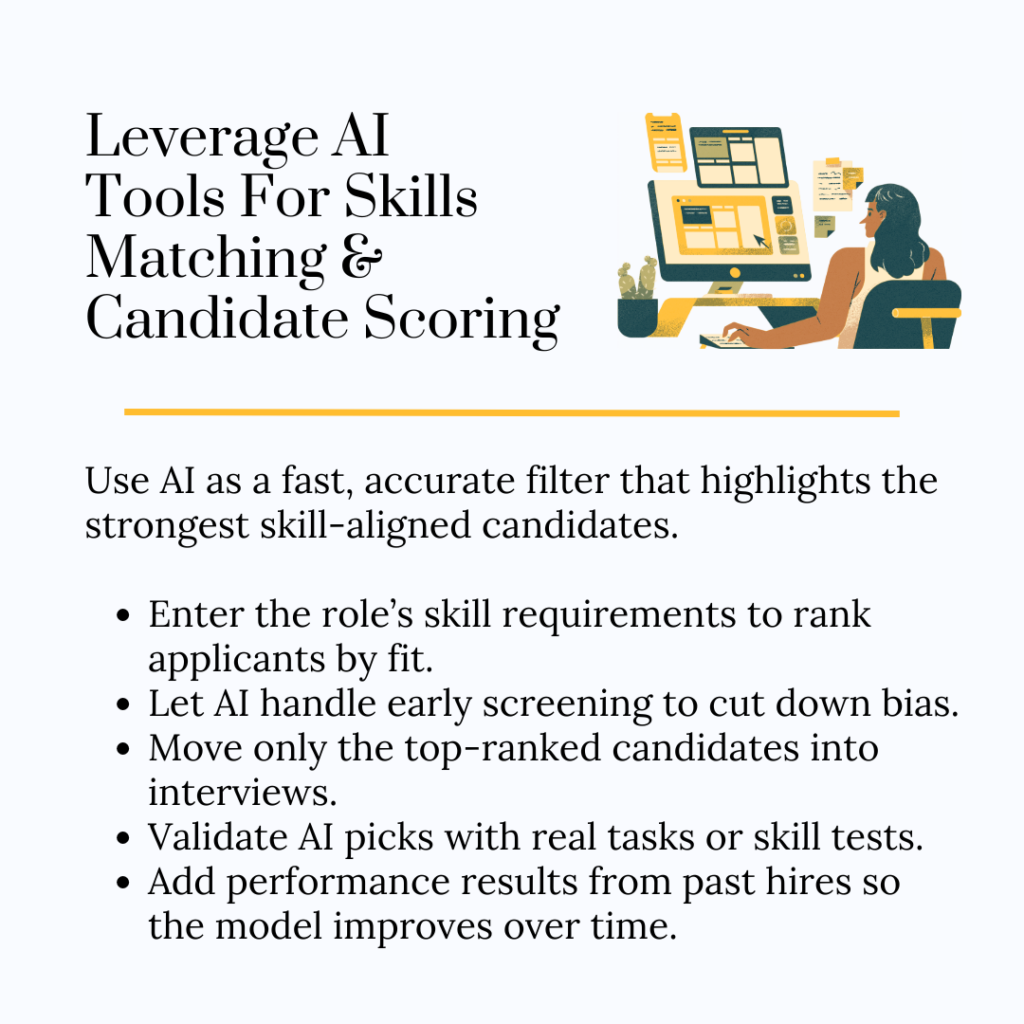
AI isn’t a replacement for judgment. It is a filter that surfaces the right candidates faster and more accurately.
What to Do:
- Upload job requirements and let AI rank candidates for skill fit. This reduces human bias in early rounds.
- Combine AI with human review. Only interview top AI-ranked candidates, then validate necessary skills with projects or tests.
- Feed back performance data on hires so the system learns which skill sets predict success.
Example:
This city-based pet euthanasia provider leaned into AI because its hiring needs shift constantly across different cities. They started by feeding the AI tool the exact capabilities their mobile veterinarians rely on — experience with in-home procedures, confidence in guiding families through sensitive decisions, and the ability to manage unpredictable field conditions.
Once they uploaded new role requirements, the system immediately ranked incoming applicants by how closely their skills matched the real work. The hiring team only reviewed the top matches and checked them against real case notes or sample communication logs.
They also included performance data from each city. Feeding those outcomes back into the system sharpened the rankings over time. It turned into a setup where the AI quietly caught the details that humans usually miss, and the team could spend their time confirming fit rather than searching for it.
8. Continuously Update Skills Framework Based On Market Trends
Skills evolve faster than you think. Yesterday’s hot skill can become table stakes. Regular updates keep your workforce future-ready and make sure new hires walk in with the skills that matter right now.
What to Do:
- Scan industry trends quarterly. Monitor emerging tools and certifications in your sector.
- Talk to internal teams. Managers usually see gaps before HR does. Ask what skills are becoming essential or underutilized.
- Review and revise the framework annually and adjust skills. Use this for hiring and learning initiatives.
Example:
MedicalAlertBuyersGuide treats their skills framework like a living thing because their space moves quickly – new devices, new safety standards, new user expectations. They set up a routine where their editorial and research teams drop updates into a shared tracker every time they spot a new feature trending in the medical alert world.
When fall detection accuracy became a bigger deal, they added specific technical skills around comparing sensor performance. When seniors started asking more about caregiver app integrations, they added competency requirements around evaluating usability across different age groups.
They also built a small “trend sprint” into their workflow every quarter. Two researchers spend a week reviewing FDA updates, reading through device manuals, scanning tech forums, and talking to users who rely on these systems every day.
Whatever patterns they find get folded directly into their skills framework – sometimes as new technical criteria, sometimes as soft skills like explaining device limitations clearly for first-time users. By the time they revisit the full framework each year, half the work is already done.
9. Monitor & Analyze Hiring Metrics
Hiring doesn’t end when someone signs on the dotted line. If you want skills-based hiring to actually work, you need to track what is happening at every step.
What to Do:
- Track conversion rates at every stage of your hiring funnel to pinpoint where candidates are dropping off. Focus especially on whether skills assessments filter out strong candidates unfairly or leave gaps.
- Compare candidates’ assessment scores and real work output to see which evaluation methods predict success most accurately.
- Set up dashboards or reports that track long-term outcomes. Use these metrics to continuously tweak assessments, interview processes, and job descriptions.
Example:
Rosie knew that even the best skills-based approach could fall apart if no one was tracking results. They started by building a live dashboard that mapped every step of their hiring funnel for salon support roles.
From the moment a candidate applied to the point they were fully onboarded, the team tracked conversion rates. They quickly noticed that some applicants with excellent tech skills were dropping off during the initial scheduling test, which meant the assessment was unintentionally filtering out strong candidates.
Next, they compared assessment scores to actual on-the-job performance. That insight pushed them to tweak the evaluation process, adding a mini “rush-hour simulation” so they could see how applicants performed under pressure.
They also tracked long-term metrics like retention and time to full productivity for new hires. By keeping an eye on these numbers, Rosie could adjust tests, interview questions, and even job descriptions continuously to make their hiring fairer and more effective with each cycle.
Conclusion
Skills-based hiring gives companies a level of control they didn’t have before. You get teams that perform with fewer delays and far fewer “wrong fit” situations that drain budgets and morale.
So, if you are going to adopt one long-term hiring strategy, make it this one. Keep your skills data updated. Train managers to rely on evidence. Build assessments that show you who can actually do the work today.
One more thing...
You didn't start freelancing to spend hours every week searching through job boards. You started freelancing to do more work you enjoy! Here at SolidGigs, we want to help you spend less time hunting and more time doing work you love.
Our team of "Gig Hunters"—together with the power of A.I.—sends you high-quality leads every weekday on autopilot. You can learn more or sign up here. Happy Freelancing!