In this article:
- How LinkedIn Optimisation Reached Its Limits
- What LLM Visibility Actually Means
- The Search Behavior Shift Driving This Change
- How Personal Branding Services Are Restructuring Their Offerings
- What the Next Two Years Look Like for Personal Branding Services
Personal branding services are going through a significant recalibration. The strategies that worked on LinkedIn three years ago are hitting hard ceilings, while large language models are reshaping how professionals get discovered. The question for anyone investing in a personal brand right now is simple: where does visibility actually come from?
The answer increasingly points away from LinkedIn and toward the AI platforms where decision-makers now do their research.
How LinkedIn Optimisation Reached Its Limits
LinkedIn’s algorithm currently delivers posts to roughly 2-5% of a creator’s network. In 2022, that number was closer to 15-20%. That drop matters because personal branding services built their entire value proposition around the idea that consistent LinkedIn content would compound over time. The math no longer supports that assumption.
The constraints are measurable. A post needs 1,000+ impressions within the first hour to get pushed to a wider audience. The average LinkedIn user has between 500 and 1,000 connections, with engagement rates sitting at 2-4%. Content disappears from feeds within 24-48 hours. When you do the arithmetic, 500 connections multiplied by a 2.4% reach rate equals about 12 viewers per post.
The Algorithm Factors That Shape Distribution
LinkedIn ranks content based on dwell time above three seconds, reaction velocity within the first 30 minutes, and connection strength scores. Video gets 3x the distribution of text posts. Carousels earn 2.2x weighting. Text-only updates receive baseline distribution.
None of those factors is within a creator’s direct control. A professional can produce excellent content and still get buried because the first comment didn’t appear within 20 minutes of publication.
What LLM Visibility Actually Means
LLM visibility refers to how consistently a professional appears in responses generated by large language models like ChatGPT, Claude, and Perplexity AI. The reason it matters is that AI search engines now deliver synthesised answers rather than ranked lists of links, and those answers are drawn from a specific body of indexed content.
The average LinkedIn profile reaches 1,247 unique viewers per month. By comparison, comparable executive search terms generate around 47,000 monthly queries across AI assistants. That gap is what’s driving the pivot.
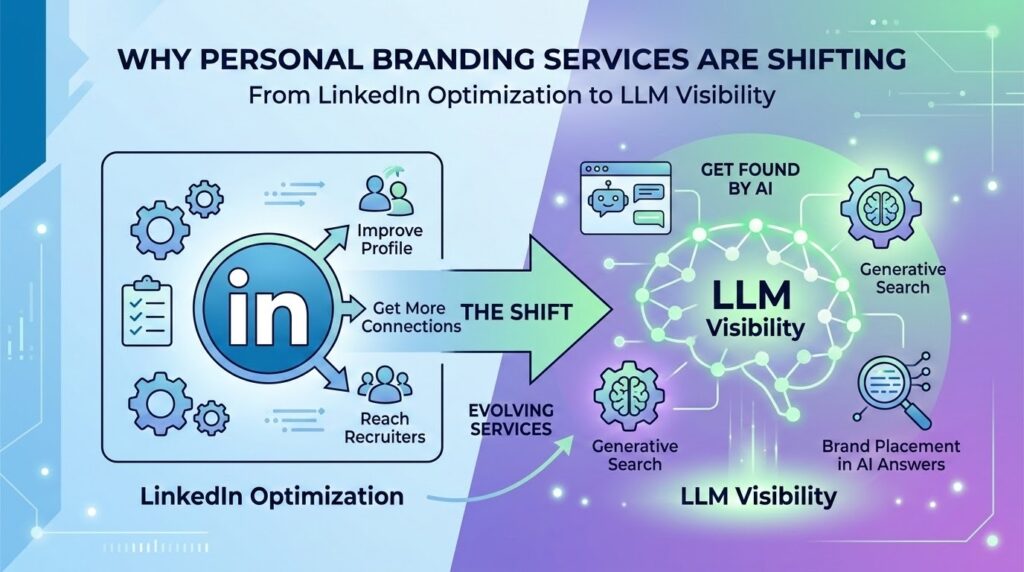
For a name or brand to surface in LLM responses, three factors need to be in place: mention frequency across multiple sources, domain diversity so authority signals don’t concentrate in one place, and temporal distribution that shows consistent relevance over time. A professional who appears in 12+ instances across six or more domains with consistent context is far more likely to be cited by an AI platform than someone with a well-optimized LinkedIn profile.
How AI Platforms Actually Surface Names and Expertise
Pre-training data ingestion pulls content from web crawls into the model’s knowledge during development. Retrieval-augmented generation surfaces relevant information during active inference when users ask questions. Knowledge graph entity matching compares queries against structured data to identify relevant individuals.
Contextual relevance scoring evaluates how closely brand mentions align with specific topic areas. This is why isolated mentions don’t build AI visibility. Consistent positioning within a defined area of expertise across multiple independent sources earns a place in AI-generated responses.
The Search Behavior Shift Driving This Change
Average queries to ChatGPT contain 18.4 words. Average Google queries contain 3.2 words. That difference in query length reflects a fundamentally different information-seeking behavior. Users asking longer, more contextual questions expect synthesized expert answers, not a list of links to evaluate.
Perplexity AI processes 150 million queries per month. Most return zero-click answers that never send users to external pages. Google’s AI Overviews cite three to seven sources per response based on entity prominence. The visibility that used to come from ranking on page one of Google now depends on whether a professional’s name and expertise appear in the sources an AI system selects.
Why Content Format Has to Change
Personal branding services have started converting short-form LinkedIn updates into 1,500-word articles structured for LLM ingestion. The reasoning is straightforward: large language models need enough context to recognize topical authority. A 150-word post doesn’t provide that. A well-structured long-form piece with clear entity signals does.
Adding Person and Organization schema markup to personal websites is another important adjustment. Schema markup helps AI search engines interpret and categorize individual brand entities, which improves how a professional appears in knowledge graph results.
How Personal Branding Services Are Restructuring Their Offerings
Agencies that previously focused on LinkedIn content calendars are now operating across multiple tracks. The service tiers that have emerged reflect this shift. LinkedIn-only packages run around $2,500 per month. LLM visibility packages start around $4,800. Full AI-first strategies, which cover entity optimization, structured data, content repurposing, and platform monitoring, cost around $7,200. Roughly 40% of clients are choosing the highest tier.
The core service components that drive results in the LLM tier include:
- Entity optimization audits that evaluate brand signals across digital platforms and identify gaps in knowledge graph coverage
- Content repurposing workflows that transform LinkedIn posts into long-form indexed content
- Structured data implementation to improve how AI platforms interpret professional credentials and expertise areas
- Brand mention monitoring across AI platforms to track how professional reputation is appearing in generative outputs
Firms like NetReputation have documented how consistent cross-platform presence affects entity authority, particularly as AI search surfaces become a primary discovery channel for professional services. The mechanics are similar whether someone is managing a corporate reputation or building a personal brand.
What the Next Two Years Look Like for Personal Branding Services
Gartner’s projection puts 65% of B2B buyer research through AI assistants by 2026. Personal brands that haven’t built entity authority across multiple platforms by then will face a structural disadvantage. Buyers won’t search for them. They’ll ask an AI, and if the AI doesn’t surface them, they may as well not exist.
The EU AI Act will require source attribution transparency across 12 European countries starting in 2026. That regulatory shift makes brand mention tracking a compliance requirement in some markets, not just a performance metric.
OpenAI has signaled plans for a verified expert citations feature, which would create a meaningful citation advantage for verified entities. Getting into position ahead of that kind of feature requires building the entity authority now, not after the feature launches.
Quarterly audits of brand mentions across AI training sources are becoming standard practice for serious personal branding clients. The tools to do this, including Brand24 for monitoring and Kalicube Pro for entity audits, are already widely used. The clients who treat LLM visibility as an ongoing strategy rather than a one-time setup will be the ones who hold positions in AI-generated responses as these platforms continue to evolve.
The shift from LinkedIn optimization to LLM visibility isn’t a trend. It’s a response to where professional discovery actually happens now.
One more thing...
You didn't start freelancing to spend hours every week searching through job boards. You started freelancing to do more work you enjoy! Here at SolidGigs, we want to help you spend less time hunting and more time doing work you love.
Our team of "Gig Hunters"—together with the power of A.I.—sends you high-quality leads every weekday on autopilot. You can learn more or sign up here. Happy Freelancing!