In this article:
- Who This List Is For, and the Three Questions a Renewal Actually Turns On
- The Six SEO Analysis Tools, in the Terms a Contract Uses
- The Enterprise SEO Tools You Already Pay For, and What They Cover
- The Specialist You Add When the Platform’s Number Stops Being Defensible
- The Free Layer You Should Not Be Paying for Twice
- Which Line Item to Defend First
- Frequently Asked Questions
Our platform renewal reached my desk in February at $38,400 for the year, eleven days before the planning cycle closed. I run a fourteen-person marketing org at a $60M ARR B2B SaaS company, and three of those people work inside SEO analysis tools every day. My CFO didn’t ask whether the software was any good. He asked what would break if we let it lapse, and I couldn’t answer him in one sentence. That silence isn’t rare: 43% of companies cut some of their SEO spending in the past year.
Maria Georgieva runs SEO at Payhawk. She framed the evaluation problem the way a budget holder hears it: your boss still expects SEO to show business impact. The board question is: what does this contract change about the numbers I present next quarter? So I rebuilt the shortlist around three questions no feature page answers: what an SEO analysis tool lets you prove, what you keep if you leave, and what you pay for twice.
Who This List Is For, and the Three Questions a Renewal Actually Turns On
This list is for marketing VPs and directors at B2B companies doing $50M to $250M. Marketing runs 10-40 people, 2-6 on SEO and content, and you personally approve the multi-year contract for enterprise SEO tools and defend it upstairs. It’s written for the person who signs.
Two numbers frame the review: fewer than half the tools in the average stack are actually being used, and US marketing leaders grade their own ability to demonstrate return from their technology at barely above the midpoint. Decision criteria for enterprise SEO tools, in order:
- Reporting that maps keyword movement to pipeline contribution.
- A site audit that checks 115+ technical parameters.
- API access inside the plan tier you’d buy.
- A full data export you keep after canceling.
- Overlap with the free first-party sources.
We judged these SEO analysis tools on those criteria and on published contract terms.
The Six SEO Analysis Tools, in the Terms a Contract Uses
This SEO software comparison counts contract terms, because budgets have not moved and more than half of enterprise CMOs already say there is not enough of it. The six SEO analysis tools below are lined up on proof, API placement and exit terms.
| Rank | Tool | What it lets you prove | API in the plan you would buy? | Your data after you cancel | Entry price, monthly |
|---|---|---|---|---|---|
| 1 | SE Ranking | Rank, audit and AI-answer movement in one place | Yes, API and MCP on every plan | Not published | $129, or $103.20 billed annually |
| 2 | SEOmonitor | Campaign ranking movement and AI Overview presence | Yes, capped at 10,000 requests a day | Export for 30 days, then deleted | EUR 99, yearly toggle saves 17% |
| 3 | Semrush | Position, site health and AI search performance | No, Advanced $549 plus separate units | Deleted no sooner than 30 days, no export right | $139, or $117.33 billed annually |
| 4 | Advanced Web Ranking | Rankings across 4,000+ engines, plus AI visibility | No, Agency $279, then unlimited | Processing stops within 30 days, archived 6 months | $139, with a 10% annual discount |
| 5 | Profound | Brand presence across multiple answer engines | Enterprise only, quote only | Not published | Quote only |
| 6 | Google Search Console | Full query and URL performance, no row limit | Free daily export to your BigQuery | Stays in your BigQuery project | Free, plus BigQuery storage and queries |
The Enterprise SEO Tools You Already Pay For, and What They Cover
Four enterprise level SEO tools carry an annual contract a marketing org renews. The renewal question: what does yours cover that you buy elsewhere too? European rules now give a customer the right to take their data out inside 30 days, with switching fees banned outright from January 2027.
1. SE Ranking
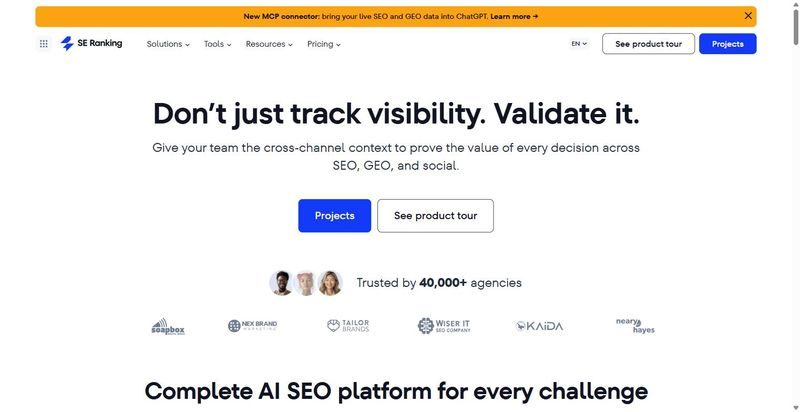
Among SEO analysis tools, SE Ranking puts API and export access in the entry plan.
You Deserve Better Clients...
We can help you find them. Just send us the details and we'll hunt down leads that match your business needs. All on autopilot.
Why it works for the budget owner: Benjamin Bloom, a VP analyst in Gartner’s marketing practice, put the test plainly: business value is the yardstick CMOs should use to evaluate investments, rather than vendor hype. At renewal, that yardstick is portability, and SE Ranking keeps API and MCP access on every plan tier, entry one included.
Standout feature: Core ships 25,000 Data API credits a month and Growth 100,000, so moving keyword, backlink and audit history into a warehouse starts on the entry plan. The SEO audit tool behind it runs 115+ checks across 13 categories, with JavaScript rendering on both plans.
Pros:
- Tracks five AI engines in one view: AI Overviews, AI Mode, ChatGPT, Gemini and Perplexity
- Crawls 250,000 audit pages a month on Core and 2,000,000 on Growth
- Runs a 14-day trial with no card, enough to test an export
Cons:
- Publishes no post-cancellation retention window, so the fate of your history is undocumented
- Ships one manager seat on Core, so a three-person team is on Growth from the start
Pricing: Core is $129/mo, or $103.20/mo billed annually. Growth is $279/mo, or $223.20/mo billed annually. The Agency Pack starts at $69/mo on annual billing.
What the line item buys: What this line buys is an answer to the question no feature page addresses: if we leave, what leaves with us? The retention silence is a real gap, and I’d want it in writing. But the export door opens on the plan you already pay for.
2. SEOmonitor
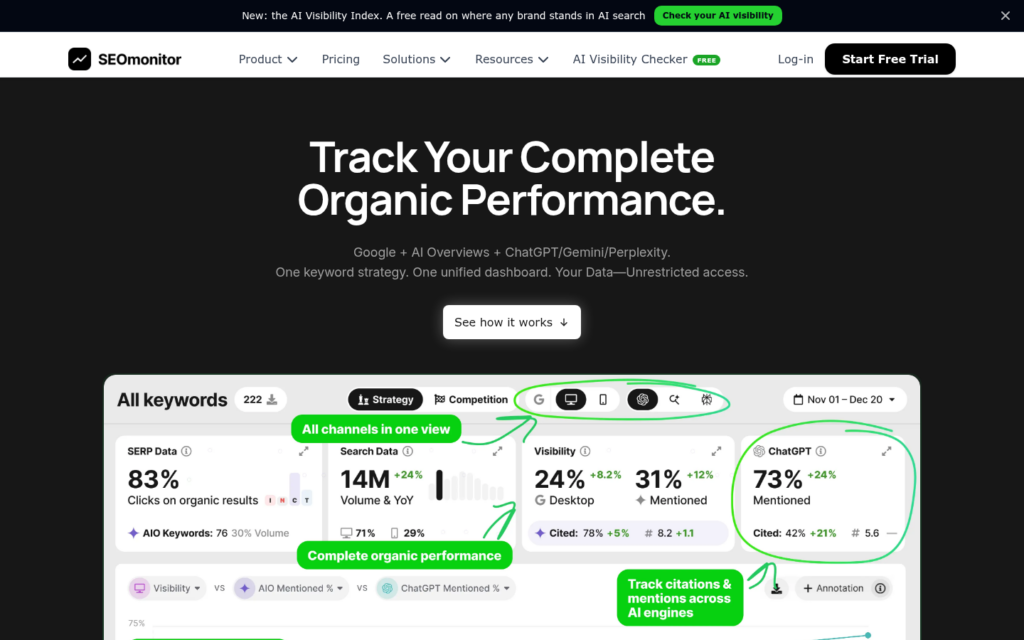
Among paid SEO analysis tools, only SEOmonitor’s own terms put a 30-day export right in writing.
Why it works for the budget owner: Its Terms of Use give you 30 days to export your data before it’s deleted or anonymized. That’s a clause you can quote in a renewal review, and hold them to.
Standout feature: Seats are free and uncapped on every plan, so the SEO report tool costs the same whether three analysts open it or thirty executives do. Pro adds a Looker Studio connector and unlimited API access, capped at 10,000 requests daily.
Pros:
- Puts the export right in its contract terms
- Includes uncapped seats on every plan
- Bundles API and beta MCP into Pro
Cons:
- Caps Starter at one tracked campaign
- Deletes profiles irreversibly, taking every sub-user’s access
- Canceling leaves a data gap it cannot backfill
Pricing: Starter EUR 99/mo, 1,000 keywords; Pro EUR 299/mo, 3,000. The vendor advertises 17% off yearly with no per-tier figure.
What survives the review: The export clause. Most vendors here say what they may delete; SEOmonitor says what you may take, and puts a date on it. I’d budget Pro as the real entry, and verify that export before anyone touches the delete button.
3. Semrush
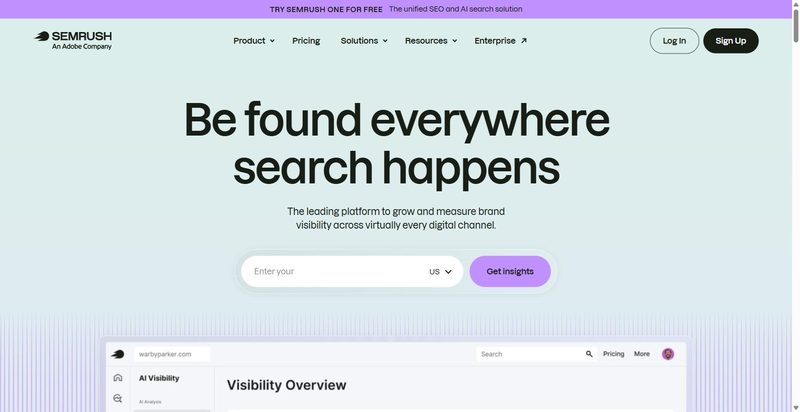
Semrush is the incumbent on most SEO analysis tools contracts: broad coverage, and familiar to most analysts you’ll hire.
Why it works for the budget owner: The coverage spans keyword, site and AI-answer work, and most analysts have used it before. Onboarding cost at renewal is close to zero, and that is what keeps it on the list.
Standout feature: Prompt monitoring sits in the same subscription as the ranking data: 50 tracked prompts daily on Starter, 100 on Pro+, 200 on Advanced. For a VP reporting AI visibility beside organic positions, that’s one dashboard and one invoice on the same renewal.
Pros:
- Tracks AI answers and classic rankings under one subscription
- Covers 40 websites and 5,000 keywords daily on Advanced
- Shortens the hiring ramp on a familiar interface
Cons:
- Gates API data integration to Advanced at $549/mo, with units bought separately
- Prices additional logins from $45/mo, so each executive view is another line
- Sells white-labeled and link-shared reporting as a $20/mo add-on
Pricing: SEO $139/mo, Starter $199/mo, Advanced $549/mo; billed annually those are $117.33, $165.17 and $455.67/mo. Enterprise is quote only.
The exit cost: Its terms give you no export right, and they let Semrush erase your data at any point from 30 days after expiry or termination. That’s the clause I’d read before signing again: what you built here is a report, not an asset you keep.
4. Advanced Web Ranking
Advanced Web Ranking is a rank tracker that takes seats out of the pricing conversation entirely.
Why it works for the budget owner: Every plan carries unlimited users and unlimited projects, so a forty-person marketing org doesn’t renegotiate at forty-one. Seat models are where these contracts quietly inflate, and this one removes the lever.
Standout feature: Advanced Web Ranking publishes the most specific post-cancellation policy of these SEO analysis tools. Processing stops within 30 days, then the account is archived for six months before permanent removal. That’s a checkable answer to what you keep if you leave, and a clock.
Pros:
- Carries unlimited users and projects on every plan
- Publishes a dated retention window
- Tracks AI search visibility without a tier upgrade
Cons:
- Gates API access to the Agency tier, so entry-plan reporting stays manual
- Ships no crawler, so a separate SEO audit tool stays budgeted
Pricing: Pro $139/mo, Agency $279/mo, Enterprise $699/mo; annual billing is advertised as a 10% saving, no per-tier figure.
What the line item buys: A tracking line whose cost doesn’t move when the org does, and an exit you can put a date on. It won’t cover the audit work your platform already pays for, so it sits beside that contract as a second line on the budget.
The Specialist You Add When the Platform’s Number Stops Being Defensible
Nearly every specialist ask in 2026 is the same: an AI-answer tracker. Roughly a sixth of the marketing budget at large companies is already earmarked for AI, out of a line that funded something else. Add one only when your SEO analysis tools stop making the board’s number.
5. Profound
Profound tracks brand presence across answer engines, and that’s the whole case for a second subscription.
Why it works for the budget owner: It answers the board’s question: when buyers ask an engine about your category, does your name come back? Check your incumbent first: SE Ranking, Semrush and Advanced Web Ranking all report AI-answer visibility on existing plans.
Standout feature: The free trial runs 10 prompts once, against ChatGPT alone. Enterprise is where the product lives: custom prompt volumes checked daily across Perplexity, Google Gemini, Claude and Microsoft Copilot, with a dedicated Slack channel and a 24-hour SLA specialist attached.
Pros:
- Reports across four named answer engines on Enterprise
- Runs a free trial before any sales call
- Widens coverage far past ChatGPT on Enterprise
Cons:
- Keeps API access behind Enterprise, outside any published plan
- Markets unlimited seats while the master agreement caps users per order
- Promises to promptly return or delete data, with no window given
Pricing: A free trial, then Enterprise, quote only.
What survives the review: Fund it the quarter AI visibility becomes a line the board asks by name. Then make the vendor prove the outcome, because close to half of martech leaders say the AI features their vendor sold them have not delivered what was promised.
The Free Layer You Should Not Be Paying for Twice
Most paid SEO analysis tools contracts wrap data Google gives away, and a renewal review should say which slice. 85% of the advertisers buying their way into AI Mode were not ranking organically for the same term: spend on a gap an analysis tool should have found.
6. Google Search Console
Google Search Console’s Bulk Data Export to BigQuery is a daily raw feed the Search Console interface never shows you.
Why it works for the budget owner: The destination is yours. Data lands in a Google Cloud project you control, so an executive dashboard costs nothing in licence terms. It prices what SEO analysis tools add on top.
Standout feature: The bulk data export is not affected by the daily data row limit. That settles the vendor pitch about full query data. Three tables land in your dataset daily: site impressions, URL impressions with search-appearance flags, and an export log.
Pros:
- Exports every query and URL row for the property
- Replaces seats with IAM, since the project is yours
- Handles properties with tens of thousands of daily queries
Cons:
- Starts from zero, since the export is not retroactive
- Excludes anonymized queries, so the long tail stays partly unnamed
- Puts the BigQuery bill on you, with no automatic expiry
Pricing: Free from Google. BigQuery: $6.25 per TiB scanned, first 1 TiB free monthly; active storage about $23.55 per TiB per month, first 10 GiB free monthly.
The exit cost: There isn’t one. The dataset sits in a Google Cloud project you own, so canceling changes nothing about what you hold. Treat that as the floor paid SEO analysis tools have to clear, and check Chrome UX Report the same way before renewing anything that bills you for a performance score.
Which Line Item to Defend First
Four situations cover almost every SEO software comparison I have sat through, and each points at a different line: the platform you already own, the tool that proves value upstairs, the tracker that ignores seat count, and the AI-visibility specialist.
If SE Ranking is among the enterprise SEO platforms you own: defend it. API and MCP sit inside every plan.
If your problem is proving value upstairs: fund SEOmonitor. Few SEO analysis tools pair forecasting, a business-case SEO report tool and a published export right.
If seat sprawl across a large marketing organization drives cost: Advanced Web Ranking carries unlimited users across plans, rare among enterprise SEO platforms.
If you’re asked to fund AI visibility separately: Profound is the specialist you’d buy after your platform’s own AI coverage runs out.
Where the contract lands: among US marketing leaders, the marketing share of company revenue has fallen to its lowest point in five years. The renewal question arrives every year. Write the memo before it does.
Frequently Asked Questions
What is enterprise SEO software?
Enterprise SEO software is the system a large organization uses to track rankings, audit its own pages, study competitors and now watch ChatGPT and Gemini answers, at a scale spreadsheets can’t hold. An enterprise SEO software platform is the best SEO software tier procurement buys: seat controls, API access and audit trails.
What criteria should guide SEO tool selection?
Three questions decide SEO tool selection. What does the tool let you prove to people who approve budgets? What data can you export and keep if you cancel? And what does it duplicate that Google Search Console already gives you free? Answer those three before you compare SEO analysis tools.
How much does enterprise SEO cost?
Published tiers are a floor, not a bill. Four drivers move the real number: seats, tracked keywords or AI prompts, API credits, and add-ons like white-label reporting. SE Ranking’s entry tier is Core at $129/mo, or $103.20/mo billed annually. Price the drivers you’ll actually consume before you sign.
One more thing...
You didn't start freelancing to spend hours every week searching through job boards. You started freelancing to do more work you enjoy! Here at SolidGigs, we want to help you spend less time hunting and more time doing work you love.
Our team of "Gig Hunters"—together with the power of A.I.—sends you high-quality leads every weekday on autopilot. You can learn more or sign up here. Happy Freelancing!